
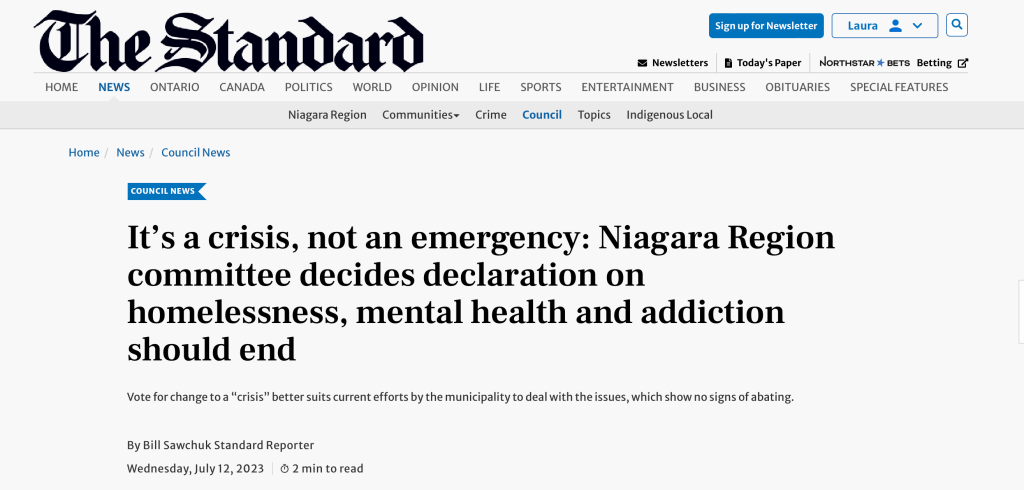
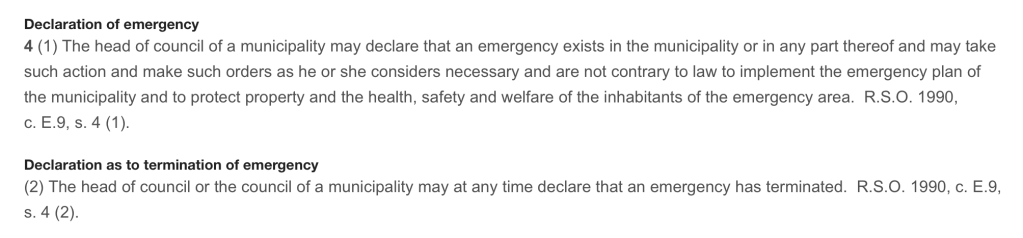
They’re not emergencies and they’re certainly not emergencies under the Emergency Management and Civil Protection Act, R.S.O. 1990, c. E.9.
Let’s begin with a couple of definitions…
Our first definition is from our friends at Merriam-Webster

Our second definition is from Ontario’s Emergency Management and Civil Protection Act

It’s no secret that I was opposed to declaring states of emergency on homelessness, mental health, and addictions when we did it back in February.
I voted in favour of the meaningful and actionable pieces of that motion (many of which I had brought before Council in the past and which were passed by Council at those times), but the actual declarations are nothing more than a public relations move that, ultimately, don’t lead to meaningful change in the community.
Generally, what we’re all familiar with in terms of declaring a state of emergency are things like winter storms (hello, Christmas 2022) or flooding (hello, Port Colborne and Wainfleet in 2019) or, yes, during pandemics (hello, COVID-19).
Emergencies end. We know when an emergency is over, and let’s be extremely frank here, there will never be zero unhoused people. There will never be zero people with mental health needs. There will never be zero people living with addiction.
So, given that declarations of emergencies also have to come to an end at some point, are we going to come up with magic numbers? Are we going to declare that, I don’t know, 125 unhoused people is an acceptable number of unhoused people? Are we going to declare that 750 people with mental health needs who can’t access supports is acceptable to us? Are we going to declare that 317 people living with addiction and unable to access supports is acceptable? What are our magic numbers for ending the emergency declarations? Because, again, none of these things will ever be impacting zero people.
Furthermore, in the six months since Council declared these emergencies, there have been no results that can be tied to the declarations. All of the work that has been being done for years and that continues to be done is because Council and staff (mostly staff, as we all know) have been doing it anyway.
The correction to the funding formula for programs and services for unhoused individuals? Staff and Council have been advocating for that for years. The 2021 Auditor General’s report noted it, and the province’s response to the Auditor General’s report was that they would fix it. The funding correction coming very shortly after the declarations was coincidental.
All of the work that the Region does around homelessness, mental health, and addictions has been being done, it continues to be done, and staff report to us about it very regularly. We also can ask staff about it at any time, and they’re always (in my experience) happy to respond to us to answer questions and/or provide clarification.
Niagara declared states of emergency for these three incredibly complex and often (but not always) overlapping issues, and the province and the feds said, ‘yep, we hear you, and here’s what we’ve been doing.’
They did not suddenly commit more funding (which is what we need) or making the housing market accessible (which is what we need) or make mental health care free and accessible for all (which is what we need).
So, now, we have a situation where – because of having declared emergencies, Niagara Region Emergency Operations Centre (which we’re required to have under the Act) meets bi-weekly to discuss what they’re doing to manage and mitigate the emergencies…and these are issues that are so big, so complex that they cannot be managed the way storms or floods are managed, which is what the Niagara Region Emergency Operations Centre is meant to do. The Operations Centre is not meant to manage these issues.

By declaring states of emergency, we have created a make-work project for staff. We’ve required them to have meetings and provide us with summary reports about how the emergencies are being managed.
We are taking them away from doing the actual work that needs to be done.
We are taking them away from doing the actual work they have been doing.
We are requiring reports from them that are redundant but also not nearly as detailed as the reports we already get from staff who are already doing the work, because they’re experts in doing the work.
We don’t need declared states of emergency to continue to invest as much as we can (as much as the taxpayers will permit) in trying to alleviate/resolve these issues.
We don’t need declared states of emergency to communicate to the public how important these issues are.
By transitioning our declaration to acknowledge that homelessness, mental health, and addictions are crises (and, let’s be honest, they have been for a very long time and will continue to be for a long time), we have the tools we need to hold elected officials accountable in their decision-making, including what they will invest through the budget in these issues and what they will advocate for from the province and the feds.
Declared states of emergency, which requires particular things from us under the Act, are nonsensical, to – again – be frank. They require work of staff that accomplishes nothing.
If we need to declare emergencies to communicate with the public, we need to do a better job communicating.
If we need to declare emergencies for symbolism and to take these issues seriously, we need are serving no one in any meaningful way.
If we need to declare emergencies to justify taking meaningful action on these issues, we are not doing our jobs.
These issues are crises, and we can act on them; we can be held accountable for our decisions and actions in dealing with them based on declaring them crises, rather than emergencies under the Act.

 Laura Ip - Regional Councillor