
Let’s have a look.
In Bob Gale’s letter to Minister Flack of Wednesday, March 4, 2026, he recommended the following voting system:
Weighted voting based on population
That each mayor’s vote at Regional Council be weighted according to population in increments of 15,000 residents (e.g., a municipality of 100,000 residents would have six votes; a municipality of 6,000 residents would have one vote), reflecting both representation by population and municipal diversity.
That this would reflect “municipal diversity” is laughable, but I’ll just stick to the math for now.
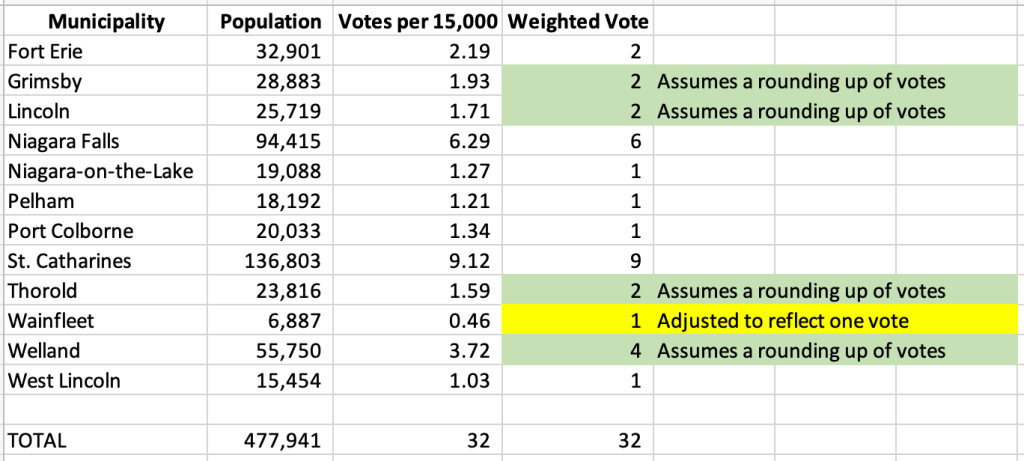
I’ve been generous in the math to give Wainfleet one vote (Gale’s letter says they’d get one, even though they don’t reach the 15,000 increment), and I’ve rounded up for Grimsby, Lincoln, Thorold, and Welland. I’ve no idea if this is Gale’s intention, but it does ultimately reflect the current number of Regional Councillors.
With this generous math, the mayors of Niagara Falls (6), St. Catharines (9), and Welland (4) control every single Regional vote with their combined weighted total of 19 of 32 votes.
Three people get their way every single time.
In a previous post, I mentioned that although I can’t recall a time it’s ever happened, some people are concerned that because St. Catharines (for instance) has so many Regional Councillors (6 + the mayor), they could swing a vote their way. In seven years, I can’t recall a time when every Councillor who represents St. Catharines at the Region has voted the same way on anything that wasn’t a unanimous vote of all of Council.
Now, though? Under this recommendation from Bob Gale?
Three people. All the power on Regional Council.
And, if, say Welland’s mayor doesn’t agree with the mayors of Niagara Falls (6) and St. Catharines (9)? That’s okay. They only need to get a mayor who has two votes to agree with them (for a total of 17 of the 32 votes), and they get their way.
So, yes, you’ll get *more efficient* decision-making alright, because it won’t matter won’t most of the mayors think.
This isn’t what anyone meant by representation by population.

 Laura Ip - Regional Councillor
One thought on “Who will control Regional Council?”