
In a previous post, I discussed the significant problem with weighting the votes of only 12 Regional Councillors (presumably, the mayors of each local area municipality in Niagara).
You can go back and read that post or have a look at the math here:
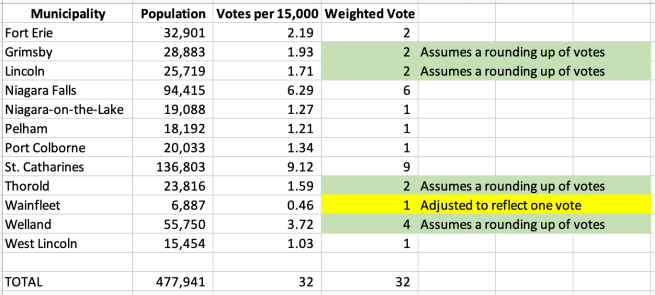
and see that this would put the control of every vote in the hands of the people representing St. Catharines and Niagara Falls. They would only ever need the help of one other municipality. Everyone else might as well not even bother giving any decisions any thought, because they’re only there to meet quorum.
This isn’t democratic.
However, the other idea I’ve seen floated is to give each of the twelve people a single vote.
This also isn’t democratic and flies in the of the basic principle of representation by population.
So, what’s the answer?
I don’t know exactly, but I think it has to be a mix of a majority of weighted votes and a particular number of municipalities as well.
If St. Catharines and Niagara Falls are in favour of or opposed to a particular issue, then I think they have to be required to also have at least three (or maybe four?) other municipalities be on the same side.
If seven (or eight?) municipalities are in favour of or opposed to a particular issue, then the vote goes they way those seven (or eight?) members vote, regardless how many votes they actually have. So, if, for instance, Grimsby (2, if we’re rounding up), Lincoln (2, if we’re rounding up), Niagara-on-the-Lake (1), Pelham (1), Port Colborne (1), Wainfleet (1), and West Lincoln (1) all agree, which would be a total of nine votes, but a majority of the represented municipalities, then maybe that works to ensure that more people have to work together to make decisions that affect the entire region.
Again, I don’t know the answer; I’m just mulling ideas.
I think it’s very clear that it can’t just be a straightforward weighting of votes with no fail safe to protect the interests of the smaller municipalities.

 Laura Ip - Regional Councillor