If you would like to view the press conference, it can be found here.
And here is the province’s media release about it.
Continue reading “Minister Flack’s press conference on “strengthening” governance”Laura Ip – Regional Councillor
Representing St. Catharines

If you would like to view the press conference, it can be found here.
And here is the province’s media release about it.
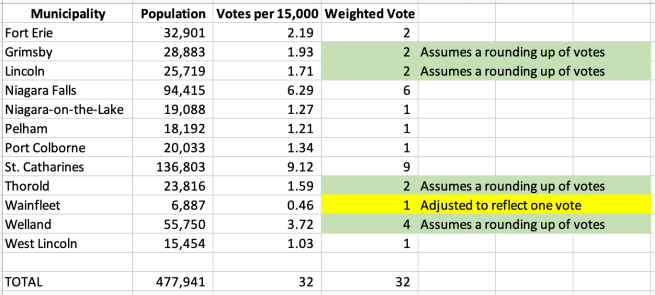
Continue reading “Minister Flack’s press conference on “strengthening” governance”In a previous post, I discussed the significant problem with weighting the votes of only 12 Regional Councillors (presumably, the mayors of each local area municipality in Niagara).
You can go back and read that post or have a look at the math here:
This is simultaneously one of the silliest arguments I’ve heard about why councillors shouldn’t be involved in this discussion and also an argument that proves my point about the necessity of community engagement/public consultation.
I’ll address, first, that it is not at all a conflict of interest for me to have an opinion on regional (or any other) governance issue. Just as I’m permitted to have an opinion and express it on the regional budget or any other matter that impacts the community at large, I am also permitted to have an opinion on regional governance, amalgamation, and/or how many elected officials there should be to serve Niagara’s communities.
But, also, as I’ve stated many times before, I’m not seeking re-election, so it’s a moot point.
Continue reading ““Politicians will never vote themselves out of a job””It’s not uncommon to hear that Niagara has too many politicians. Why on Earth would an area the size of the Niagara region have 126 elected when the province only has 124 MPPs?
Well, I mean, it’s because there are 13 government bodies in the Niagara region. There are several provincial ridings in Ontario that encompass the area of more than one municipal government.
Continue reading “Too many cooks in the kitchen?”Sitting on Regional Council is a lot of work.
If you reduce Regional Council to just the 12 mayors, who’s going to do all the work?
Continue reading “Who’s going to do all the work?” Laura Ip - Regional Councillor